


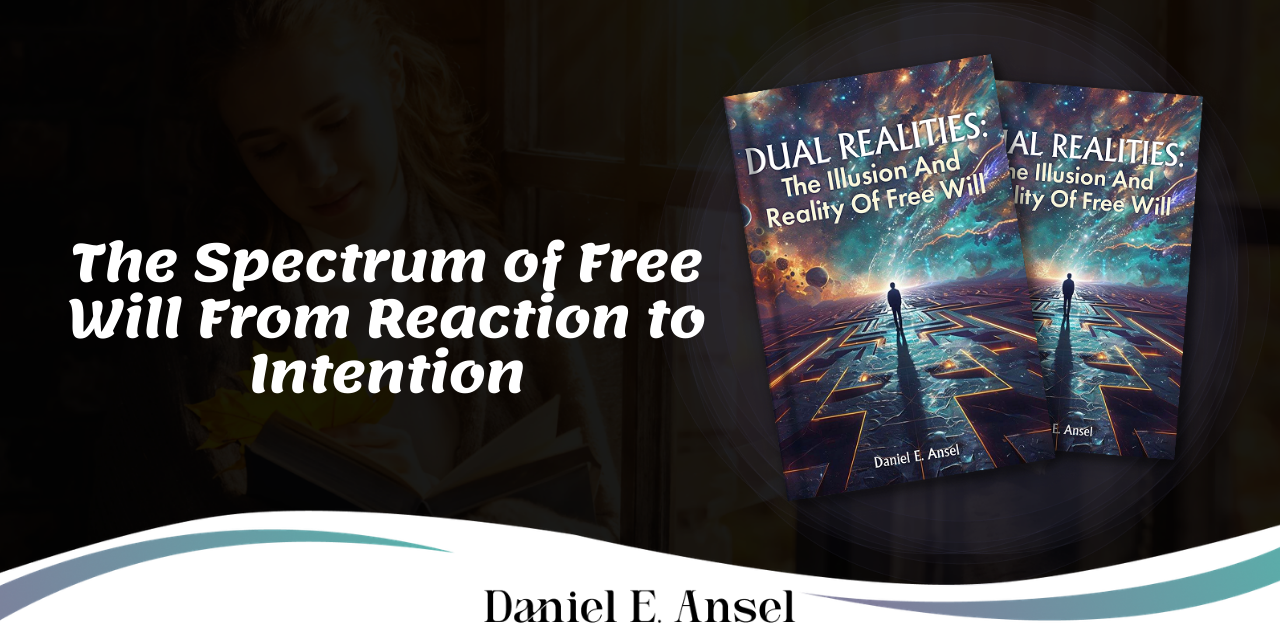
Most people think of Free Will as a simple yes-or-no question. Either we have it… or we don’t. But what if that framing is too simplistic? In Dual Realities: The Illusion and Reality of Free Will, Daniel E. Ansel presents a far more nuanced perspective. Instead of asking whether Free Will exists in an absolute sense, the book suggests that Free Will operates along a spectrum. The real question may not be Do we have Free Will? but rather How consciously are we using it?
Reactive Free Will: Living on Autopilot
At one end of the spectrum lies what can be described as reactive decision-making. This is when we operate primarily on impulse, habit, or emotional reaction. Our choices are shaped heavily by upbringing, environment, and subconscious conditioning. We respond rather than reflect. Consider someone raised in a rigid environment who never questions the beliefs they inherited. They may sincerely believe they are choosing their path, yet their decisions are guided almost entirely by past conditioning. Their actions are not forced but they are unexamined. This is where the illusion of Free Will can quietly take hold. We feel like we’re choosing. But if we never pause to ask why, are we truly exercising autonomy? Without reflection, decision-making becomes mechanical. Choices still happen, but they lack awareness. And without awareness, Free Will begins to lose its meaning.
Reflective Free Will: Awareness Begins
The next stage on the spectrum introduces something critical: insight. Reflective decision-making occurs when we begin to recognize the forces influencing us. We become aware of emotional triggers, habits, and external pressures. Instead of reacting immediately, we pause. This doesn’t mean impulses disappear. It means we see them. For example, someone struggling with destructive patterns might begin therapy and learn to identify what triggers those behaviors. The impulses still exist, but awareness creates space between stimulus and response. That space is powerful. Reflection doesn’t automatically grant complete freedom, but it increases intentionality. It shifts us from being passive participants in our own lives to active observers of our own motivations. And that shift matters.
Strategic Free Will: Designing the Future
At the far end of the spectrum lies what Ansel describes as strategic Free Will. This is where awareness is not just reactive it becomes proactive. Individuals don’t merely recognize influences; they consciously reshape them. Imagine someone who grows up in difficult circumstances but studies the patterns that limit opportunity. Rather than accepting those patterns as destiny, they actively work to break cycles, seek mentors, and design a different future. They are still influenced by their environment. But they are no longer blindly responding to it. They are shaping it. Strategic Free Will doesn’t deny the existence of constraints. Instead, it acknowledges them and works within them intentionally.
The Erosion of Autonomy
The book presents a powerful example of how Free Will can quietly erode without us realizing it.
Picture someone who moves through life on autopilot. They wake up, go to work, follow routines, consume familiar media, and make decisions based on what feels expected rather than what feels examined. They accept promotions because it’s the logical next step. They pursue milestones because “that’s what people do.” They make major life choices without ever asking why. Years later, they may feel unfulfilled but struggle to identify how they arrived there. Nothing dramatic happened. No one forced their hand. They simply never paused to reflect. This absence of self-examination doesn’t mean Free Will was taken away. It means it was never fully exercised.
Why the Spectrum Matters
Seeing Free Will as a spectrum changes everything.
It moves the debate away from abstract arguments and into lived experience. Instead of arguing about determinism versus libertarianism, we begin asking more practical questions:
- How often do I question my motivations?
- How much of my behavior is habitual?
- When do I pause before acting?
Free Will becomes less about metaphysics and more about mindfulness. The book makes it clear that complete independence from influence may not be realistic. Genetics, environment, past experiences, and subconscious processes all shape us in ways we cannot fully escape. But awareness gives us leverage. Even if we cannot eliminate influence, we can examine it. And examination changes how we respond.
Free Will as a Practice
One of the most powerful implications of this spectrum is that Free Will is not static. It can strengthen. It can weaken. It depends on how often we engage in reflection. If we never question ourselves, we drift toward reactive living. If we consistently reflect, we move toward intentional living. In this sense, Free Will is less like a possession and more like a muscle. It develops through use.
Where Are You on the Spectrum?
The most important takeaway from this framework isn’t theoretical. It’s personal. Where do you fall? Are you reacting? Reflecting? Strategizing? There may not be a single answer. Most of us move along the spectrum depending on the situation. The key is not perfection it’s awareness. Because the moment you begin asking, Why am I choosing this? you are already stepping further into the reality of Free Will. And that step, however small, changes everything.