


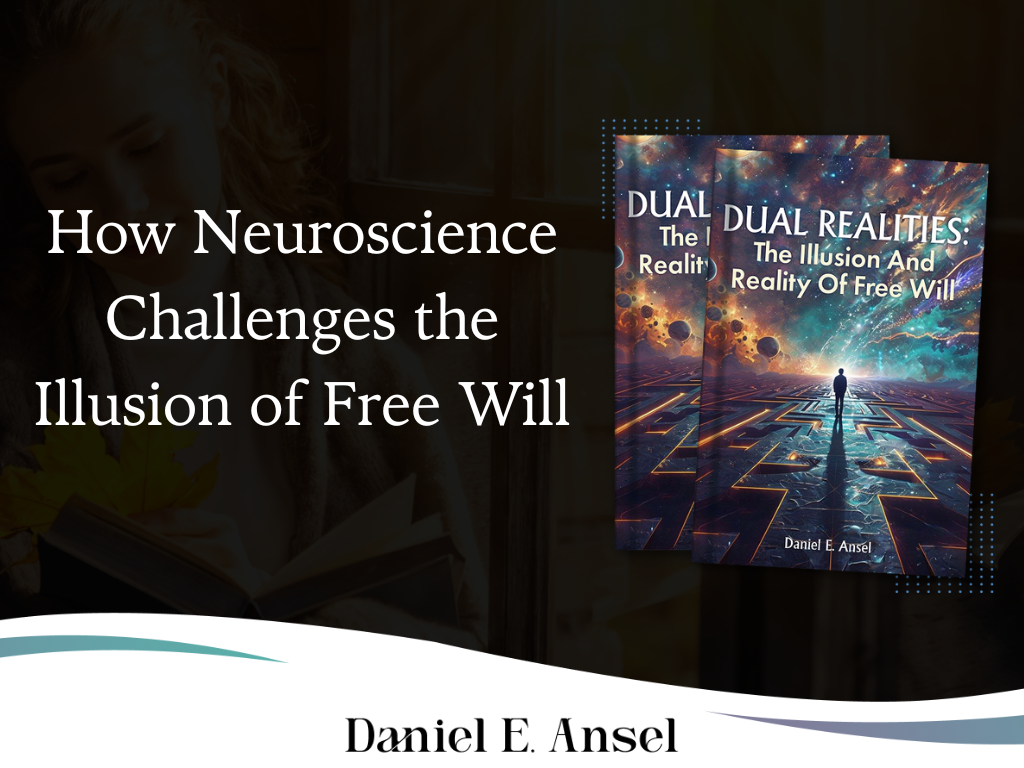
Whether we are really the ones in control or not, this is a question that has been the subject of debate among philosophers over the centuries, however in the recent decades, neuroscience has taken this debate to a whole new level. This book routes directly to this crossroad as brain research today makes our most treasured belief, that we are the conscious creators of our own lives, so incomprehensible. Although society is constructed on the premise that actions are the decisions we make freely, neuroscience has it that we may be making decisions well before we even know that we do it.
Visit: Daniel E. Ansel
The greatest evidence that we can provide consists of the renowned experiments which revealed that the brain makes a decision a couple of milliseconds before we are aware of it. These works, which are mentioned all over the book, disagree with the belief that action is triggered by conscious thought. Rather, they propose that the brain matches the movement or choice decision before the level of awareness, and then it is the task of consciousness to defend the decision once it has been taken. This unconscious process does not eliminate the existence of free will, but it brings into disturbing view the fact that the decision-maker we think we are may be merely describing the outcomes of neural processes that have already been initiated.
The book further elaborates on the developing of neural pathways using genetics, early experiences, trauma and learning. These tracks affect our desires, fears, avoids or pursuits which we may not even be conscious of. The tendency to grab a comfort food on stress and even lose temper without considering it first, these examples are reflections of what the brain has encoded long before responding to some situation. Neuroscience thus unfolds that a large deal of deliberate behavior we perceive is in fact the repetition of previous imprints. This is particularly critical in the operation of habits. What appears to be a free choice is, in many cases, the firing of pathways which are well-trodden and disengage the conscious will.
It is the other idea developed in Dual Realities that the emotions affect the decision-making. The emotional centers of the brain tend to override the reasoning aspect and force people to make impulsive decisions despite the fact that they know better. This brain game reveals that free will is not as easy as mind over matter, but a dynamic battle involving various sections of the brain. The illusion of total control arises as we are usually conscious of the logical explanations, but not of the emotional outbursts that preceded them. Neuroscience proves that behavior is in many cases motivated by emotional signals, activated way before one even thinks.
There is another layer of this illusion, which is cognitive biases, which are also addressed in the book. Framing effects, confirmation bias and social influence are subconscious forces that influence the way people process information. These subconscious filters render some decisions to seem rational, moral or inevitable when they are in reality the by-products of mental shortcuts. In these regards free will is not the pure autonomy as it appears but rather the ability to go through a brain that is efficient but not objective.
However, Dual Realities does not leave the readers desperate. Although neuroscience reveals certain serious constraints about the freedom of choice, it is also a way to enhance autonomy. The book claims that insight, which is achieved by means of reflection, attention to one’s inner processes, can widen the ability of a person to make a deliberate action. Automatic patterns can be disrupted by getting more aware of biases, emotional triggers, and habitual responses. Neuroscience demonstrates that the brain is plastic; it is rewireable with effort.
These insights are also related to the extensive questions of responsibility and morality which the book relates. When actions are initiated before the person realizes it, what does it imply to hold a person entirely liable? Dealing with responsibility and accountability is an essential element in the functioning of society, but neuroscience promotes a more caring attitude where the connection between biology, surroundings, and consciousness is acknowledged.