


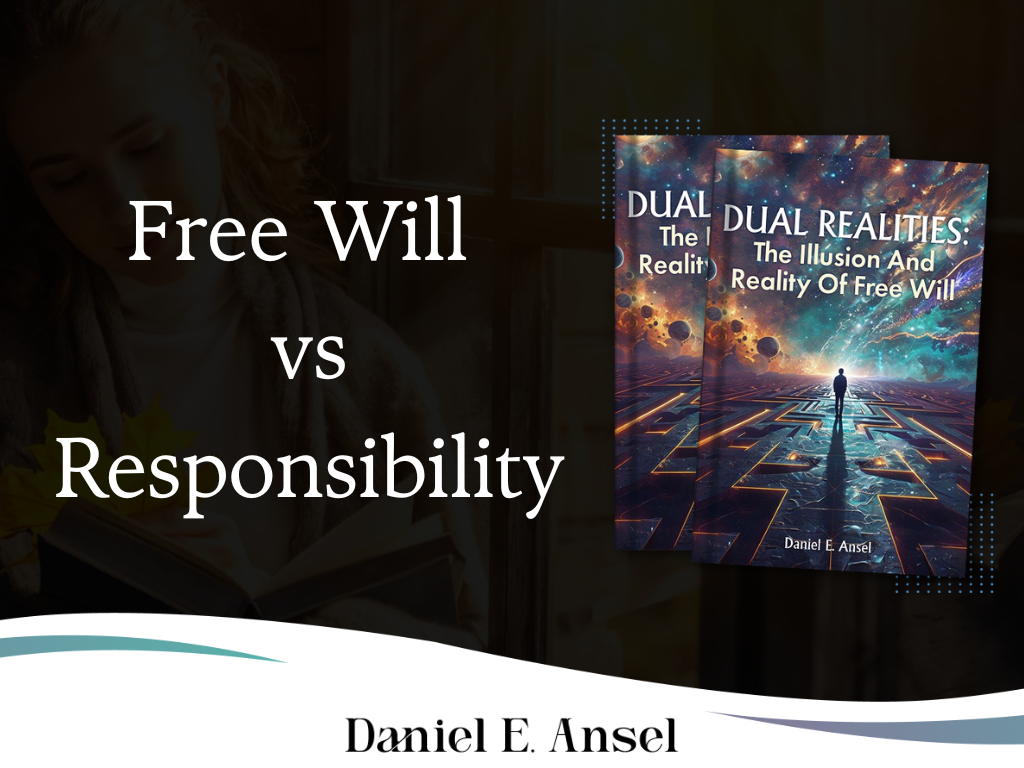
Free will and responsibility is one of the main topics in Dual Realities: The Illusion and Reality of Free Will. Although, society is relying on the notion that individuals are in charge of their behavior, neuroscience and psychology show that to a large extent, human behavior is influenced by forces that are not under the conscious mind. This raises a philosophical and practical question: is it the case that when people make choices, they are affected by their biology, the world around them, and the subconsciousness of their actions, in which case to what degree do they ever really have full responsibility of what they do? This is the fine line that this book walks, with the book presenting a subtle insight into how the existence of free will and responsibility may exist in the human mind in a complicated environment.
Visit: Daniel E. Ansel
The classical understanding of responsibility presupposes individuals to be free in making their decisions, and thus, to be praised or blamed on the decisions they take. It is on this basis that the legal systems, social norms, and moral judgments are constructed. Nevertheless, in Dual Realities it becomes evident that there is a complication of this assumption when we remember that there exist numerous decisions which we take based on factors which we are not conscious of. The behavior can be greatly influenced by genetic inclination, childhood events, emotional plumbing and cognitive prejudices long before an individual appraises a circumstance. These forces are not an excuse to act negatively but they argue the fact that decisions have not always been made freely and independently.
However, responsibility is not entirely disregarded in this book. Rather, it brings about a more realistic and humane interpretation of the meaning of responsibility. The book postulates that even though one has no control over the early impulses that come to him or her, he or she can develop the awareness and skills that will be able to control his/her reactions. In this respect, responsibility is interconnected with insight, the capacity to identify internal forces and the ability to plan behavior. Such a view recognizes the fact that free will has its boundaries and does not dismiss the significance of ethical responsibility.
Mental illness, trauma, and social environments are also discussed in the book in relation to responsibility. The judgment and control of impulses may be severely compromised due to depression, addiction, or anxiety. On the same note, an individual brought up in a violent or destabilizing background may come up with behavioral styles that are hard to modify. Although in many ways the society demands people to overcome these situations in the strength of sheer determination, Dual Realities presents a more humane opinion.
Simultaneously, the book underlines that nonetheless responsibility remains one of the key elements of social order. Society would also not run smoothly without the people being held responsible with regard to their actions. The point as the book puts it is to strike a balance between accountability and awareness. Being responsible should not be pegged on unrealistic demands of perfect autonomy, but a perception of human behavior that includes conscious decision-making and unconscious control. Such a medium course enables justice without disregarding the psychological and neurological realities that determine the action of a human being.
The book also points out the effect of beliefs on the free will on behavior. Research on dual realities reveals that individuals who subscribe to the belief in free will are more responsible in their behaviors, whereas individuals who believe that behavior is predetermined have less motivation to control their behavior. This fact implies that despite the possible limitation of free will, the belief in it can be useful. Responsibility is no mere concept of morality; it is a motivational concept. It challenges people to make effort to make the right decisions, irrespective of the limitations in operation.
In the end, Dual Realities: The Illusion and Reality of Free Will, gives a fair and thought-provoking perspective of the connection of free will and responsibility. It recognizes that the behavior of a human being is subject to subconscious processes, emotional stimulation, and environmental motivation. However, it also confirms that the knowledge and the self-understanding can widen the bounds of individual self-control.